Velika Mrdakovica · Grave NG 5 · 2nd half of the 1st century AD
Rhyton
A glass drinking vessel shaped like a horn. The only one of its kind in Croatia. One of eighteen in the world.
And it was found — of course — right here, below Vodice.
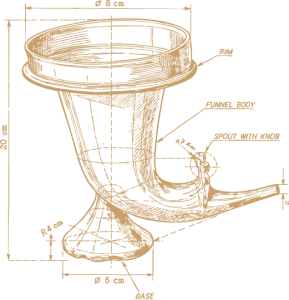
Conjectural reconstruction · rim Ø 8 cm · height 20 cm · foot Ø 5 cm
First question
So what exactly is a rhyton?
A rhyton is a drinking vessel shaped like a horn. The name comes from the Greek verb rheō — to flow. That is the whole point: the horn is not simply a cup of unusual shape, but a vessel through which the drink passes. At the narrow end it has an opening rather than a base.
Which means that, as a rule, you cannot fill a rhyton and calmly set it down like a beer glass. As long as there is wine in it, someone has to be holding it — a finger over the opening, or a mouth beneath it. The drink is not sipped, it is released.
A vessel that forces you to finish before you can put it down. Roman design, two thousand years ahead of marketing.
The Arauzona piece is interesting because it does have a foot — a modest, splayed one — so it can stand. But its spout emerges sideways, at the point where the body bends into a knee, and tapers to a point. At that bend sit two applied glass knobs, or prunts — what the drawing labels spout with knob.
This is why the type appears in the literature as a snail-like rhyton — the body and spout join in a coil reminiscent of a snail shell. The catalogue of the Šibenik City Museum names it exactly that: a glass snail-like rhyton.
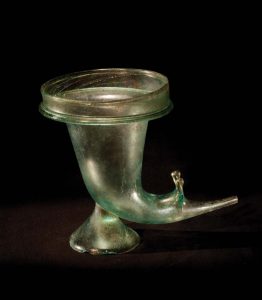
Archive of the Šibenik City Museum
The find
Grave NG 5, trench 3, the year 2011
When archaeologists of the Šibenik City Museum opened trench 3 in 2011 — 75 square metres set against the south-eastern edge of the area Zdenko Brusić had excavated in the seventies — it yielded five Roman graves of the early empire. The fifth was NG 5.
The rhyton was not lying loose in the soil. It was inside an urn — a large, locally produced ceramic urn of a shape that persisted in this region for centuries. The urn was capped with a stone slab, ringed by a series of stones, and set into a partly cut cliff face. Beside it lay a handled ceramic jug.
Next to the grave, excavators recorded iron nails and the deliberately smashed remains of another ceramic jug. That “deliberately” is not speculative poetry — breaking vessels was part of the ritual.
Inventory of grave NG 5
Nine objects and one rarity
The grave goods were not chosen at random. According to the beliefs of the time, a person used the same things in the afterlife as in life — which is why the material from the necropolis is almost identical to that from the settlement on the crest of the hill fort. Plates people had eaten from served as urn lids. Balsamaria holding ointments were thrown onto the pyre or placed directly in the grave. The oil lamps were there to light the way.
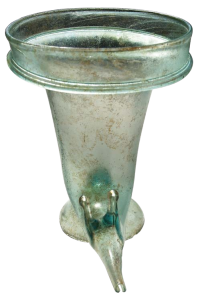
Frontal view
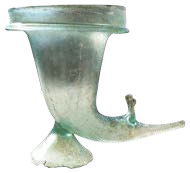
Profile
Purpose
Not everybody drank from this
The catalogue is unusually direct here. Rhyta, it states, “have emphasized symbolic and iconic significance. They are used in protocols and rituals, for drinking at symposiums and banquets, and are exclusively intended for individuals of higher social class and greater spending power.”
Translated into present-day terms: this was not an everyday cup. This was the object you brought out when you needed to demonstrate that you knew what a symposium was, that you had connections across the sea, and that you could afford to import glass which breaks at every second transfer of cargo.
And where does Arauzona come in?
Precisely in the detail that is easy to skip past. The rhyton is not a local product — it is an import. And imported items, as Brajković puts it, give “a direct insight into the relationship of the town with the flow of modern developments of the world”.
Which means: someone lived on this hill in the 1st century, knew what was fashionable in Rome, had the money to acquire it, and was important enough for it to be burned and buried alongside their bones. A Liburnian village? Not quite.
Trade ran through the port of Zaton, and Velika Mrdakovica sat on the road linking Jader (Zadar) with Salona (Solin), the capital of the Roman province of Dalmatia. From the summit you can see the Vodice waters, the Krka estuary, the hill fort on Bribirska glavica, Šibenik’s St. Michael. Geostrategically, it was a rather good address.
The imports across the necropolis say the same: amber and pottery from the Greek colonies on the eastern Adriatic, terra sigillata from Arezzo and Aquileia, the southern Gallic workshop of La Graufesenque, bottles stamped by Syrian-Palestinian workshops. Did Arauzona export anything in return? Possibly the widely known Liburnian wine — but that, the catalogue concedes, remains a pleasant assumption for now.
Context
How the rhyton ended up in an urn
The Liburnians left us no written account of their own funerary customs. Almost everything we know comes from what remained in the ground — and from the Roman parallel, which by the 1st and 2nd centuries was already deeply rooted here.
The reconstruction runs roughly as follows. The deceased is carried on a wooden bier or in a crate — simpler or more lavish depending on age and importance, which is why every grave contains a handful of nails and rivets. In the procession behind the body walk sons with veiled heads, daughters with dishevelled hair, and the wailers, theatrically beating their chests and scratching their cheeks.
The pyre is square, covered with dark leaves, surrounded by cypress branches. The closest relatives set it alight with their faces turned away. The name of the deceased is called out three times. Into the flames go the things they loved.
Then wine is poured over the embers, the bones are collected, sprinkled with perfume and placed in an urn. The responsible person speaks the formula Ire licet — it is permitted to go — and the mourners are released.
The vessel someone had drunk from was left with the dead, so that they might go on using it. Pragmatic to the last.
The final round
One detail from the catalogue is particularly lovely. Beside the graves — outside them, or right at the boundary — excavators repeatedly found thin-walled vessels, the finest tableware of the period, used exclusively for drinking. They turn up often enough that coincidence is ruled out.
The assumption: immediately after the urn was laid down and the grave arranged, those cups were used to drink one last time in honour of the deceased, probably with some formula spoken — and were then set beside the grave. Two thousand years later, on more or less the same spot, people are raising glasses again. Continuing the practice is, quite literally, in our job description.
A banquet at the edge of the necropolis
During the 2013 campaign, trench 7 produced something unexpected: a great quantity of animal bones, mussels, murexes and sea snails of the species Thericium vulgatum. The bones point to a banquet organised according to Roman custom in honour of the deceased, shortly after burial — or to burnt offerings.
The place is most likely an ustrinum — an enclosed area for cremation — or some other cult site. Nor can it be ruled out that the snails served to produce dye: the murex Hexaplex trunculus secretes the pigment from which imperial purple was made, which gram for gram fetched prices on the market higher than gold. Smaller communities looked for a cheaper variant — and evidently found one.
The place
The town that was called Arauzona
The site is known today as Velika Mrdakovica — a hill not far from the right bank of the Krka which, honestly, does not stand out from its neighbours in any particular way. It is slightly higher. That is all.
Yet three ancient sources mention a town that almost certainly stood here:
Claudius Ptolemy · 2nd c.
A Greek mathematician, astronomer and geographer, a native of Egypt. In his Geography he lists Arausona (Άραυζωνα) among the continental towns of Liburnia — as one of eight thousand urban units of the Mediterranean. He even supplies coordinates: 42°30′ / 44°20′.
Anonymous of Ravenna · 7th–8th c.
In his Cosmography he mentions Arausione among the coastal towns of the eastern Adriatic and Dalmatia.
Antonine Itinerary · 2nd–3rd c.
Describing the provincial roads, it places Arausa 46,000 paces from Trogir, 30,000 from the (still unlocated) Praetorium and 20,000 from Blandona near Stabanj, in the hinterland of Lake Vrana.
In antiquity the river Krka was called Titius. Arauzona lay in its lower course — that much is certain. That it stood precisely here is not: no inscription bearing the town’s name has been found, so strictly speaking one can only argue in terms of high probability. But the quantity and variety of local and imported material singled out Velika Mrdakovica as the most likely location — and local and foreign scholarship agree on that.
What stood on the summit
The hill fort settlement was enclosed by a double stone wall fortification. The earlier line, of unworked stone, formed a crest around the upper third of the hill — the first line of defence. The second, of dressed ashlar, has so far been located on the western side, just below the crown.
Only a small part of the walls survives. The rest served generations of farmers for centuries as ready-made building material for houses, barns and dry stone walls. The Roman town, in practical terms, went into the surrounding field boundaries.
Local memory had it, only slightly differently
In 1888 the schoolteacher Frane Škarpa recorded, in the Viestnik of the Croatian Archaeological Society, what people in Vodice and Zaton were saying: that Velika Mrdakovica had been a great town, and that it was called Bela. That men from Vodice, digging between the walls of a house, had found a gold ring. And that, as always, treasure was buried somewhere.
The name Bela is not Arauzona, the ring vanished into private hands, and the treasure — well, that depends on what you count as treasure. Until the first half of the 20th century there were vineyards south of the hill fort, the land was worked intensively, and something regularly came up out of the soil to “see the light of day”.
And it would have rested there, had Mile Ševerdija of Zaton not spent years carrying fragments of pottery from Velika Mrdakovica to Šibenik, convincing the archaeologists of the Šibenik City Museum that it was “definitely worth starting to dig” here. The whole of Arauzona’s archaeology rests, to a considerable degree, on one persistent man from the next village.
By the numbers
The necropolis in six figures
~130
graves from the 1969–1974 excavations
15
new graves in the 2011–2013 campaigns
18
known rhyta of this type in the world
1
of them in Croatia — this one
6
centuries of continuous life on the hill fort
15–30
cm — the depth at which the Roman graves lay
Those 15–30 cm are not merely a statistic. At that depth the roots of shrubs and trees reached the graves and drew water up through the urns by capillary action. One urn from grave NG 6 met the archaeologists in a state resembling “fresh non-fired clay” that disintegrated at every touch. Roots forced their way through the openings of one oil lamp and compromised a lamp bearing a moulded motif of a bear on its disk.
With that in mind, the rhyton was exceptionally lucky. Or had a very good urn.
Catalogue data
Type
Glass snail-like rhyton
Material
Glass, imported
Dating
2nd half of the 1st century AD
Dimensions
H 20 cm · rim Ø 8 cm · foot Ø 5 cm
Context
Grave NG 5, inside a ceramic urn
Trench
Trench 3, 2011 campaign
Site
Velika Mrdakovica (anc. Arauzona), Vodice
Excavation
Šibenik City Museum, led by Toni Brajković
Kept at
Šibenik City Museum
Rarity
The only one in Croatia · 1 of 18 worldwide
And now
The treasure chest is waking up
Brajković closes the catalogue with a memorable line: life at this place has fallen silent, but everything suggests that the Mrdakovica treasure chest will soon wake and shine once again in full splendour.
The plan is to link the three parts of the Mrdakovica complex — the Pišča cistern, the settlement and the necropolis — by a footpath into a single unit and open them to the public. Soil samples from selected ceramic and glass vessels were sent to Pennsylvania State University; chemical analyses should give a better insight into what exactly was eaten and drunk here two thousand years ago.
Besides traces of the past, the site is home to legally protected European green lizards, eagles and rabbits, plus a respectable list of Mediterranean medicinal and ornamental plants. The site is, in other words, both archaeological and botanical.
As for us — Arauzona is a beach bar in Vodice named after this town. The rhyton is our emblem. Not because it is old, but because it is exactly what we do: a vessel to drink from in good company, made better than it strictly had to be.
Two thousand years later, on the same hill, glasses are being raised again. Only the glass is thinner and the ice is better.
Sources
Toni Brajković, Velika Mrdakovica — Results of the Latest Archaeological Research (2011–2013)
Šibenik City Museum, 403rd temporary exhibition · Published by the Public Open University Vodice and the Town of Vodice · Vodice, 2014 · ISBN 978-953-58070-0-1 · English translation: Marija Mlinar
Ancient sources
Claudius Ptolemy, Geographica enarratio · Anonymous of Ravenna, Cosmographia · Antonine Itinerary · Pseudo-Scylax, Periplus
Photographs and conservation
Photographs: Archive of the Šibenik City Museum · Conservation: Martina Ćurković, Dalibor Martinović, Danijela Skelin
This page was prepared for guests of Arauzona on the basis of the catalogue cited above. For scholarly reference and image rights, please contact the Šibenik City Museum.